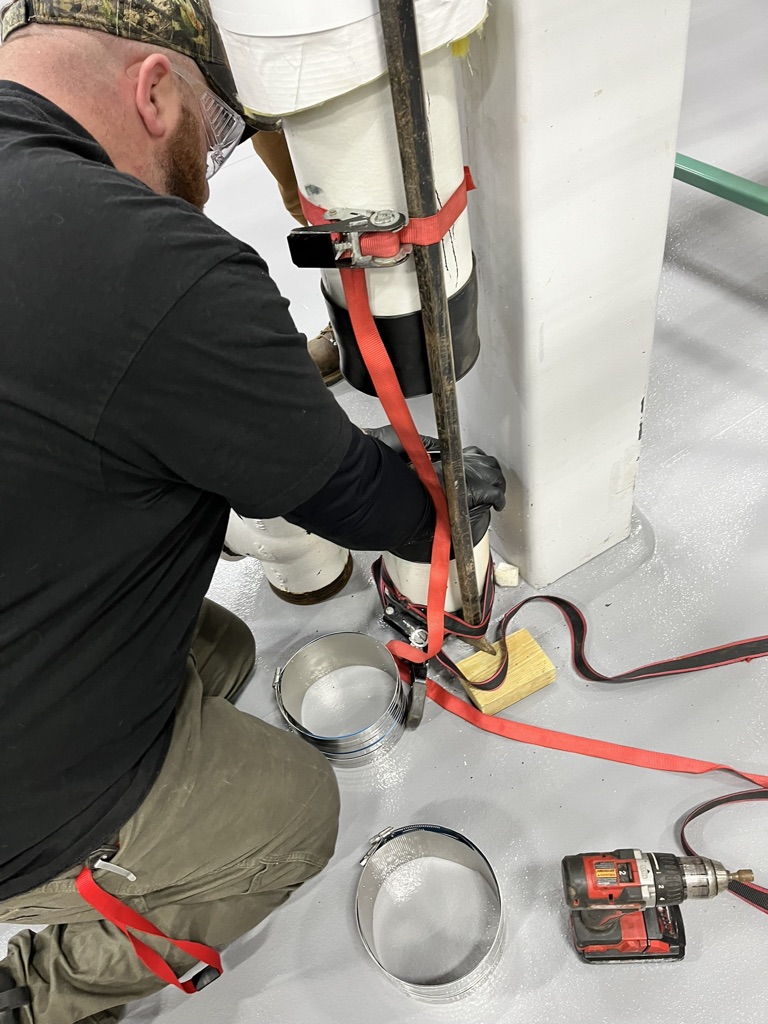


Sump pump maintenance in New Hampshire is one of those quiet homeowner responsibilities that almost no one thinks about until water is already on the basement floor. Across the Seacoast region, sump pumps run constantly through spring thaws, hard rains, heavy summer storms, and winter snowmelt events. The pump that quietly handled everything last year is the same pump that fails this year, usually at the worst possible moment, and usually because no one tested it.
A working sump pump is the difference between a damp basement and a flooded one. In older Portsmouth, Dover, and Exeter homes, where basements were never engineered for the kind of groundwater pressure modern weather patterns deliver, the pump is often the only piece of equipment standing between the homeowner and four figures of water damage. Replacing one sump pump is cheap. Drying out a basement and replacing what was stored in it is not.
The good news is that most sump pump failures are predictable, and most are preventable with a short list of maintenance checks done two or three times a year. This guide walks through what those checks look like, what the most common problems are, and where the line falls between DIY maintenance and a call to a sewer and drain professional.
In this article, you will learn about:
- Why New Hampshire homes lean so heavily on their sump pumps
- The seasonal maintenance schedule every homeowner should run
- Common sump pump problems and how to spot them early
- Battery backups, discharge lines, and the parts most homeowners ignore
- When to bring in a sewer and drain professional
Keep reading to walk away with a clear maintenance routine that keeps your sump pump working when New Hampshire weather tests it hardest.
Why sump pumps matter so much in New Hampshire homes
New Hampshire is not a forgiving climate for basements. The combination of heavy spring snowmelt, summer thunderstorms, fall nor'easters, and winter thaws keeps groundwater moving toward foundations year round. Add aging housing stock across the Seacoast, where many basements were built long before modern waterproofing standards, and the sump pump becomes one of the most important pieces of equipment in the house.
A sump pump sits in a pit at the lowest point of the basement, collects groundwater that infiltrates through the foundation, and discharges it away from the home before the water level rises high enough to flood the floor. When it works, the homeowner never notices. When it fails, the basement floods within hours.
The Seacoast region adds a few specific pressures on residential sump pumps. Coastal weather patterns deliver heavy precipitation events that test pump capacity. The freeze-thaw cycle pushes groundwater toward foundations in ways that drier climates do not see. And the rocky, well-drained soils typical of southern New Hampshire and southern Maine mean that when water does collect against a foundation, it tends to do so suddenly and in volume.
How groundwater behaves through a New Hampshire year
Groundwater pressure on a residential foundation is not constant. It rises and falls with the seasons, and the sump pump has to keep pace with whatever the weather is doing.
The pattern is fairly predictable across a year in the Seacoast region. Spring snowmelt drives the heaviest sustained pump runtime, often from late March through May, as accumulated winter snowpack melts into already-saturated ground. Summer thunderstorms create short, intense pump cycles. Fall rain events bring sustained moderate runtime. Winter freeze-thaw cycles produce unpredictable bursts of pump activity tied to warm spells.
According to the U.S. Geological Survey, groundwater levels in the Northeast follow seasonal patterns driven heavily by snowmelt and precipitation timing, which is exactly what makes sump pump readiness a year-round concern rather than a spring-only one.
Why older Seacoast homes carry higher stakes
Older homes across Portsmouth, Dover, and Exeter were not built to modern foundation waterproofing standards. Stone foundations, lime mortar joints, and aging concrete floors all let in more groundwater than newer construction.
That means the sump pump in an older Seacoast home is often working harder, more often, than the same pump would in a newer build. A homeowner inheriting a 100-year-old basement is also inheriting whatever groundwater patterns shaped it, and the pump has to keep up.
A pre-winter walkthrough of the basement, including the sump pit, often catches the early signs of pump strain before a heavy rain event exposes them. Catching the problem in October is far cheaper than catching it in April with water already on the floor.
What a sump pump failure actually costs
The cost of a sump pump failure scales with what is in the basement when the water arrives. For a homeowner with a finished basement, a single sump pump failure can produce thousands of dollars in damage to flooring, drywall, baseboards, electronics, and stored possessions.
According to the Federal Emergency Management Agency, basement flooding is one of the most common and most expensive forms of residential water damage in the United States, and equipment failure (pump failure or power loss to the pump) is a leading cause.
The cost of preventing that failure is a fraction of the cost of recovering from it. A new sump pump runs a few hundred dollars installed. A battery backup adds a few hundred more. The cost of replacing finished basement flooring is several thousand on its own, before contents.
The seasonal maintenance schedule every homeowner should run
Sump pump maintenance does not require much time, but it does require consistency. The pumps that fail are almost never the pumps that get tested. They are the pumps that sat untouched for three or four years and then got asked to handle a heavy rain event the bearings could not survive.
A simple schedule of three or four touch points a year, each lasting under twenty minutes, catches almost every failure mode before it becomes an emergency. The schedule does not need to be complicated. It just needs to happen.
The seasonal touch points worth scheduling:
- Spring (March or early April) — full test before peak snowmelt and rain season
- Summer (June or July) — quick inspection ahead of thunderstorm season
- Fall (October or early November) — full test before the ground freezes
- Winter (mid-January) — check discharge line for ice, verify pump is running clear
Spring and fall are the two checks that matter most. Summer and winter are quick verifications.
The full test (spring and fall)
The full sump pump test takes about fifteen minutes and is the single most useful piece of maintenance a homeowner can run. The steps are simple, but each one is checking for a specific failure mode.
- Unplug the pump and inspect the cord and outlet for any signs of corrosion or damage
- Lift the pump out of the pit and check the intake screen for debris buildup
- Inspect the pit itself for sediment, gravel, or anything that might restrict the float
- Reseat the pump and plug it back in
- Pour a five-gallon bucket of water into the pit and watch the float rise
- Confirm the pump kicks on at the right water level
- Confirm the water discharges fully and the pump shuts off cleanly
- Listen for grinding, rattling, vibration, or a pump that runs without moving water
A pump that hesitates, runs hot, fails to shut off cleanly, or makes unusual noise is a pump that needs attention before peak season. Catching it now is a scheduled service call. Catching it in April after a heavy rain is an emergency.
The quick check (summer and winter)
The quick check is shorter and exists to catch problems between full tests. It takes about five minutes and answers one question: is the pump capable of running if it needs to.
A homeowner checking the pump in the summer should pour a bucket of water into the pit and confirm normal operation. In the winter, the check shifts to the discharge line: walk outside, find where the pipe exits the foundation, and confirm it is not buried in snow, frozen at the outlet, or blocked by ice damming.
Discharge line failures are one of the most common winter sump pump problems on the Seacoast, and they are almost entirely preventable with a quick monthly walk-around through the cold months.
What to write down and what to track
Sump pump maintenance benefits from a small amount of recordkeeping. Most homeowners do not bother, but the homeowners who do almost always catch problems earlier than the ones who do not.
A simple notebook or note on the phone tracking the date of each test, the runtime sound, the water level the pump kicked on at, and any observed issues builds a baseline. When something changes (the pump runs longer than usual, kicks on at a higher water level, or makes a new sound), the homeowner has something to compare against.
Common sump pump problems and how to spot them early
Most sump pump failures fall into one of a small set of categories, and most are preventable with the maintenance schedule above. Knowing what to look for helps a homeowner identify a developing problem before it becomes a flooded basement.
The most common problems break down into four buckets: the pump itself, the float, the discharge line, and the power supply. Each one has its own warning signs.
The warning signs worth knowing:
- Pump runs constantly or cycles too frequently, even in dry weather
- Pump runs but no water moves through the discharge line
- Pump fails to kick on when water reaches the normal trigger level
- Grinding, rattling, or vibration noise during operation
- Burning smell from the pump motor
- Visible rust, corrosion, or sediment buildup on the pump body
- Water in the pit that rises higher than usual before the pump activates
- Pump that runs hot to the touch
- Tripped circuit breaker on the sump pump circuit
- Frozen, blocked, or visibly damaged discharge line
Any of these signs warrants a closer look. Two or more in combination usually means the pump is approaching the end of its service life.
Float and switch failures
The float is the trigger mechanism that tells the pump when to turn on and off. It is also one of the most common failure points in a residential sump pump system.
A stuck float either keeps the pump running constantly (which burns out the motor) or fails to trigger the pump at all (which lets the pit fill and the basement flood). Floats can stick because of sediment buildup in the pit, debris caught around the float arm, or simple mechanical wear after years of cycling.
During the full test, watching the float rise and trigger the pump is the most direct way to confirm the switch is working. A float that hesitates, sticks momentarily, or fails to trigger at a consistent water level is a float that will fail soon.
Discharge line problems
The discharge line carries water from the pump out of the home. Even a perfectly working pump cannot do its job if the discharge line is blocked, frozen, or damaged.
The most common discharge line issues fall into three categories. The first is winter freezing, especially at the outlet where the pipe exits the foundation and water can sit and freeze. The second is debris blockage, often from leaves, dirt, or small animals nesting at the outlet. The third is mechanical damage, often from landscaping, snow removal equipment, or the pipe simply settling and developing a low spot that holds water.
A freeze-resistant discharge fitting (sometimes called an ice guard) is a worthwhile upgrade for homes that have had discharge line freeze-ups before. It allows water to escape if the main discharge line freezes, preventing pump burnout from running against a blocked outlet.
Pump motor and bearing failures
The pump motor itself is the part that runs the most expensive failures. A motor that overheats, seizes, or burns out usually needs full pump replacement, not repair.
The warning signs for motor problems are usually audible. Grinding suggests bearing wear. Rattling suggests an unbalanced impeller. Vibration during operation suggests the pump is fighting something internally. A burning smell or unusually hot pump body suggests the motor is running too long or against resistance.
According to the U.S. Department of Energy, pump motor lifespan is significantly shortened by running against resistance, running dry, or cycling too frequently. All three are catchable during routine maintenance.
Power and electrical issues
A sump pump without power is just a hole in the floor. Power loss is one of the most common causes of basement flooding, and it almost always happens at the worst possible moment: during a storm, when the pump is most needed.
Common electrical issues include tripped circuit breakers (usually from a struggling pump pulling too much current), corroded plugs or outlets from basement humidity, and the simple problem of the pump being unplugged accidentally by another homeowner activity.
This is the case for a battery backup pump, which runs independently of household power and keeps the basement protected during outages.
The parts most homeowners ignore
The pump itself gets all the attention. But several supporting components matter just as much, and most homeowners never think about them until something goes wrong.
Knowing what they are and how to check them closes the gaps that produce most preventable flooding events.
The check valve
The check valve sits on the discharge line just above the pump and prevents water that has been pumped out of the pit from flowing back in when the pump shuts off. A failed check valve forces the pump to re-pump the same water over and over, which wears the pump out fast.
The sign of a failed check valve is usually audible: a noticeable backflow sound right after the pump shuts off, followed by the pump cycling on again sooner than expected. Replacing a check valve is a relatively cheap repair, and catching it early prevents premature pump burnout.
The sump pit cover and lid
A sump pit without a proper cover collects debris, vermin, and household dust, all of which eventually end up in the pump. A sealed pit cover also reduces basement humidity, since open pits let groundwater evaporate directly into the basement air.
A good pit cover is sealed, has a clean penetration for the discharge pipe and power cord, and includes a vent if required by local code. Replacing a missing or damaged pit cover is a fast, cheap upgrade that pays back in pump longevity and basement air quality.
The battery backup pump
A battery backup pump is a secondary pump powered by a deep-cycle battery, designed to run during power outages or if the primary pump fails. For any home with a finished basement, regular flooding history, or a high water table, a battery backup is one of the highest-value upgrades available.
The backup pump installs alongside the primary pump in the same pit and shares the same discharge line. It activates automatically when the primary pump cannot keep up or loses power. The battery itself needs to be tested and replaced every three to five years, which is part of the maintenance schedule worth tracking.
Homeowners weighing whether to add a backup often discover the answer during the first power outage they experience without one. Adding it before that moment is meaningfully cheaper.
The discharge outlet and grading
Where the discharge line exits and where it sends water both matter. A discharge that dumps water right next to the foundation is just feeding water back to the sump pit through the soil, forcing the pump to handle the same water twice.
Discharge outlets should send water at least several feet away from the foundation, ideally onto a sloped surface that carries the water further from the house. If the surrounding grade slopes toward the foundation, no amount of pump capacity solves the underlying problem.
For homes with chronic basement moisture despite a working pump, the issue is often grading or yard drainage problems rather than pump capacity.
When to bring in a sewer and drain professional
Most sump pump maintenance is reasonable homeowner work. But there are specific situations where bringing in a sewer and drain professional saves money, time, and risk.
The line is clearer than most homeowners assume. Routine testing, basic cleaning, and visual inspection belong to DIY. Anything involving a pump that is failing under load, a recurring problem that does not have an obvious cause, or a sump pump system that needs upgrading belongs to a professional.
Situations that warrant a call to a sewer and drain professional:
- Pump older than seven to ten years that has not been load-tested
- Pump that runs constantly even in dry weather
- Pump that fails to trigger during a full test
- Burning smell, grinding, or visible damage to the pump body
- Recurring basement moisture despite a working pump
- No battery backup in a home with a finished basement or flooding history
- Visible sediment, gravel, or root intrusion in the sump pit
- Discharge line problems that recur every winter
- Any sign that the pump cannot keep up with normal groundwater flow
A professional visit usually combines pump testing under realistic load, a check of the discharge line, an assessment of the pit and check valve, and a recommendation on whether the pump should be replaced, supplemented with a backup, or simply maintained.
What a typical service call covers
A professional sump pump service call from a sewer and drain contractor is more thorough than a homeowner test. The technician will run the pump against an artificial load, listen for early signs of motor wear, check the float for hesitation, and inspect the entire discharge path from pit to outlet.
The technician also brings context a homeowner does not have. Patterns across hundreds of homes in the area tell an experienced tech what failure modes are common in Seacoast basements, what brands hold up under heavy use, and what discharge configurations work for the regional weather patterns.
That context shows up in the recommendations. A homeowner replacing a pump on their own is choosing between options on a website. A homeowner replacing a pump with professional input is choosing between options that have been tested under New Hampshire conditions.
Knowing the related warning signs
Sump pump problems sometimes show up as something else first. Slow basement floor drains, recurring signs of an emergency plumbing call in the basement, or unexplained moisture issues can all trace back to a sump pump that is no longer keeping up.
A professional walk-through often identifies the connection that a homeowner missed. A sluggish basement drain combined with a pump that runs more often than it used to is rarely a coincidence, and addressing both together is faster than chasing them separately.
For homeowners who have noticed signs of a sewer backup problem in addition to sump pump concerns, the two issues sometimes share a common cause, which a sewer and drain professional can diagnose in a single visit.
What to ask a contractor before hiring
Not every contractor handles sump pump work at the level a New Hampshire basement requires. Asking a few questions up front filters out operations that treat sump pumps as a sideline rather than a real service.
Worth asking before hiring:
- Do you carry a range of pump sizes on the truck, or do you need to order parts?
- Can you install or service battery backup systems on the same visit?
- Do you offer camera inspection if the issue might involve the basement floor drains or sewer line?
- What is your typical response time for an active basement flooding event?
- Do you handle discharge line repair as part of sump pump work?
A contractor who answers all five cleanly is a contractor worth keeping. The Seacoast has plenty of operators who handle drains but treat sump pumps as a peripheral service, and the difference shows up the first time a pump fails under load.
Conclusion
A sump pump that gets tested, cleaned, and maintained on a regular schedule is a sump pump that does its job for years without drama. A sump pump that gets ignored is a sump pump that fails during the heaviest rain event of the season, almost always when the homeowner cannot do anything about it in time. The math on prevention versus recovery is not close, and the maintenance routine that prevents most failures takes a fraction of the time most homeowners imagine.
For New Hampshire homeowners across the Seacoast region, the most useful habit is also the simplest: a full sump pump test in the spring and the fall, quick checks in the summer and winter, and a basic awareness of how the pump sounds and behaves under normal conditions. That baseline is what catches developing problems early. Everything beyond that, especially pump replacement, battery backup installation, and any recurring issue without an obvious cause, belongs to a sewer and drain professional with the experience to read the system as a whole.
A working sump pump is the cheapest insurance a basement can carry. The pump itself costs a few hundred dollars. The basement it protects is worth thousands or tens of thousands. Treating it as worth a twenty-minute test twice a year is one of the highest-return habits a Seacoast homeowner can build.
For sump pump testing, replacement, battery backup installation, or any related basement drainage work across Portsmouth, Dover, Exeter, Durham, Somersworth, Rochester, Kittery, Eliot, and York, Seacoast Sewer and Drain is ready to help. Schedule a visit today and head into the next rain event knowing your pump is ready.
Recent Blog Post
Customer Reviews