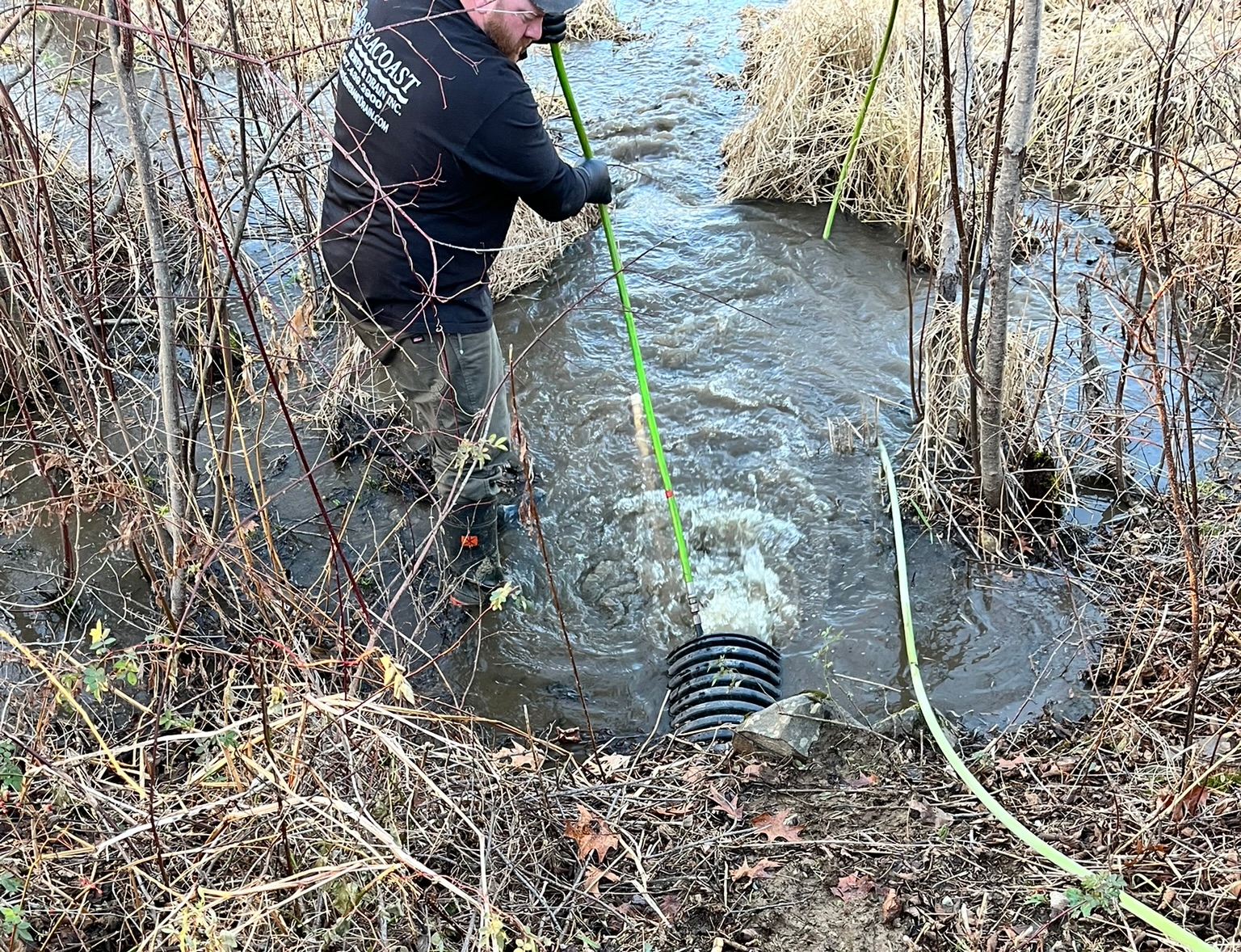


A sewer line that drained fine for twenty years can suddenly start backing up with no obvious cause. More often than not on the Seacoast, the cause has been growing underground the entire time. Root intrusion does not happen overnight. It builds slowly, season after season, until a fine hairline crack becomes a dense mass blocking the whole line.
This is one of the most common sewer problems in older New England neighborhoods, and it catches homeowners off guard because nothing changes on the surface. Research compiled by the U.S. Forest Service attributes more than half of all sewer blockages nationally to tree root intrusion, and older sewer systems with more joints are especially prone to it. The yard looks the same. The tree looks healthy. Underground, roots have been finding their way toward moisture for years, and a sewer line is often the most reliable source of it nearby.
Understanding how root intrusion actually happens, what it looks like before it becomes a full blockage, and how it gets resolved changes the outcome significantly. Catching it early usually means a straightforward fix. Catching it late can mean a much larger, more disruptive repair.
In this article, you will learn about:
- Why roots target sewer lines in the first place
- The warning signs that point to root intrusion specifically
- How professionals actually clear and prevent it
- When root intrusion becomes a bigger structural problem
Keep reading before that healthy-looking tree in your yard causes a real problem underground.
Why roots target sewer lines in the first place
Tree roots do not seek out sewer lines on purpose in the way people sometimes imagine. They seek out moisture and nutrients, and a sewer line carrying wastewater happens to be one of the most consistent, reliable sources of both anywhere near a home's foundation.
A perfectly intact pipe rarely has a root problem, since roots cannot penetrate solid, undamaged material. The real story starts with a weakness, however small, that gives roots something to reach through.
How a tiny crack becomes a real problem
Pipe joints, hairline cracks from ground settling, and small gaps around older fittings all release trace amounts of moisture into the surrounding soil. Roots are extraordinarily good at detecting that moisture gradient, and a fine root will grow directly toward it long before anyone notices anything on the surface.
Once a root finds its way into a crack, it does not stop growing. It thickens over time, widening the crack it entered through, and eventually splits into a mass of smaller roots inside the pipe itself. What started as a hairline weakness becomes a physical obstruction capable of catching debris and eventually stopping flow entirely.
Why older pipe is more vulnerable
Pipe material and age play a significant role in how likely this is to happen. Older clay and cast iron pipe, common throughout the Seacoast's older housing stock, has more joints and is more prone to the kind of small cracks that give roots an opening, part of why the median home in New Hampshire was built around 1979 matters more than it might first seem. Modern PVC pipe, with fewer joints and more flexible, seamless sections, is meaningfully more resistant.
- Clay pipe joints are a common entry point in homes built before modern PVC became standard
- Cast iron corrodes over decades, creating small perforations roots can exploit
- Pipe that has already settled unevenly develops gaps at joints even without visible damage
Which trees pose the greatest risk
Not every tree is equally aggressive toward underground pipe. Fast-growing, water-seeking species with extensive root systems, common in mature New England landscaping, tend to cause more sewer line problems than slower-growing or more compact species. According to University of Georgia Extension, trees and plants with aggressive root systems should never be planted near sewer or septic lines, since roots naturally grow toward the consistent water and nutrient supply those lines provide.
Proximity matters as much as species. A large, mature tree planted decades ago in Durham or elsewhere on the Seacoast, well before anyone thought about where the sewer line ran, is often positioned directly over or near the line simply because no one planned around it at the time.
The warning signs that point specifically to root intrusion
Root intrusion produces symptoms that can look like an ordinary clog at first, which is part of why it often goes undiagnosed until it becomes severe. A few specific patterns, though, point more directly toward roots than toward grease, debris, or a simple blockage.
Recognizing these patterns early is what separates a routine jetting appointment from a much larger excavation project down the line. None of these signs require special expertise to notice, just attention to a pattern rather than a single incident.
Recurring clogs in the same location
A clog that keeps coming back in the same drain or the same general area of the line, despite repeated drain cleaning, is one of the strongest indicators of root intrusion. A simple debris clog, once cleared, generally stays cleared. A root mass grows back.
- Note whether a clog returns within weeks of being cleared
- Track whether the same fixture or area is affected each time
- Pay attention to whether symptoms worsen gradually over months
- Consider the age and species of any large trees near the suspected line path
Slow drainage that worsens with the seasons
Root intrusion often produces a seasonal pattern that a simple drain snaking fix does not. Drainage may slow gradually through a growing season as roots expand, then seem to improve slightly during dormant winter months, only to return the following year.
This cyclical pattern is a meaningful clue, since a mechanical blockage from debris or grease does not typically follow a seasonal rhythm the way an actively growing root mass does.
What a camera inspection actually reveals
A sewer camera inspection run through the line is the only way to confirm root intrusion with certainty rather than guessing based on symptoms alone. The footage typically shows fine, hair-like roots at an early stage, thickening into a dense mat as the intrusion progresses, sometimes filling most of the pipe's diameter.
- Early-stage intrusion appears as thin, scattered root hairs at a joint or crack
- Moderate intrusion shows a visible mass restricting a portion of the flow
- Advanced intrusion can nearly fill the pipe, catching debris and causing frequent backups
How professionals actually clear and prevent root intrusion
Once root intrusion is confirmed, the right response depends heavily on how advanced it is. Early intrusion and severe, structural damage call for very different approaches, and using the wrong one wastes money without solving the underlying problem.
A camera inspection should always come before a decision on method, since guessing at the severity from symptoms alone risks either under-treating a serious problem or over-treating a minor one.
Hydro jetting for active root masses
High-pressure water jetting is the standard method for clearing an active root mass without damaging the pipe itself. Unlike a mechanical cutting head, which can leave behind fragments that regrow quickly, jetting scours the root material away from the pipe wall more thoroughly.
Jetting works best when the pipe itself is still structurally sound and the roots have not yet caused a collapse or significant deformation. This makes root intrusion jetting most effective early, since it is far less invasive and expensive than the alternative once a pipe has failed structurally.
Root treatments that slow regrowth
Beyond mechanically clearing existing roots, some treatments applied directly into the line can slow how quickly new root growth returns to the same spot. These are not a permanent fix, since the underlying crack or joint weakness that let roots in originally is still there, but they extend the time between cleanings meaningfully.
A few factors determine how well a root treatment holds up over time:
- The severity of the underlying crack or joint gap the roots originally entered through
- How aggressive the specific tree species is at regrowing toward the same source
- Whether the treatment is paired with a thorough jetting pass or applied on its own
Combining a thorough jetting with a follow-up treatment tends to outperform jetting alone, particularly in a spot with a known, persistent root source nearby.
When trenchless repair or replacement becomes necessary
Once root intrusion has caused actual structural damage, a cracked section, a collapsed area, or joints that have separated significantly, sewer line excavation or trenchless repair becomes necessary since clearing the roots alone no longer solves the problem.
Trenchless methods that restore a pipe from the inside without full excavation have become a common option in these cases, though whether a property qualifies depends on the specific extent and location of the damage found during inspection.
When root intrusion becomes a bigger structural problem
Most root intrusion cases, caught reasonably early, resolve with jetting and do not require excavation. A smaller number of cases, usually ones that went undetected for years, progress into genuine structural failures that require a very different scale of repair.
Knowing which category a given situation falls into is exactly why a camera inspection matters more than guessing from symptoms alone.
Signs the problem has gone beyond a simple root mass
A sewer line that has collapsed or separated significantly at a joint due to prolonged root pressure shows different symptoms than an active but still-intact root mass. Persistent, severe backups that jetting only partially resolves, combined with visible pipe deformation on camera, point toward structural failure rather than a clearable blockage.
Multiple problem areas along the same line, rather than a single isolated intrusion point, also suggest the pipe has reached a point where patching one section will not solve the broader issue.
The cost of waiting versus catching it early
The financial difference between early and late intervention is significant. A root mass caught while the pipe is still structurally sound typically requires jetting, a far less invasive and less expensive process than excavation or trenchless repair of a collapsed section.
Waiting through repeated clogs, treating each one as an isolated event rather than recognizing a pattern, is the most common way an inexpensive jetting job turns into a much larger excavation project.
What Seacoast homeowners can do proactively
Homes with mature trees near the sewer line's likely path benefit from periodic drain camera inspections even without active symptoms, since root intrusion can be developing well before any backup occurs. This is especially relevant given the age of housing stock across Portsmouth, Dover, Exeter, and the surrounding towns.
A short list of proactive steps reduces the odds of an intrusion progressing to a structural problem:
- Schedule a camera inspection if large trees sit near the suspected line path, even without symptoms
- Address recurring drain clogs as a pattern rather than treating each one as unrelated
- Ask about root treatment options during any jetting service to extend the interval before regrowth
- Consider a proactive inspection before planting new large trees near a known sewer line route
Conclusion
Root intrusion is one of the most common, and most preventable, sewer problems facing older Seacoast homes. It rarely announces itself clearly. Instead, it builds quietly through recurring clogs, seasonal drainage changes, and gradual worsening that is easy to dismiss as ordinary wear until the pattern becomes impossible to ignore.
The good news is that catching it early keeps the fix simple. Jetting an active root mass on an otherwise sound pipe is a far smaller job, in both cost and disruption, than addressing a collapsed section years later. The mature trees that make Seacoast neighborhoods attractive are also the reason this particular problem shows up here more than in newer developments.
A camera inspection is the only way to know for certain whether recurring clogs point to roots, and whether the pipe itself is still sound enough for a straightforward fix. That single step turns guesswork into a clear, actionable answer.
If your Seacoast property has recurring clogs or mature trees near an older sewer line, Seacoast Sewer and Drain can find out exactly what is happening underground before it gets worse. Contact Seacoast Sewer and Drain to get a real answer instead of another temporary fix.
Recent Blog Post
Customer Reviews