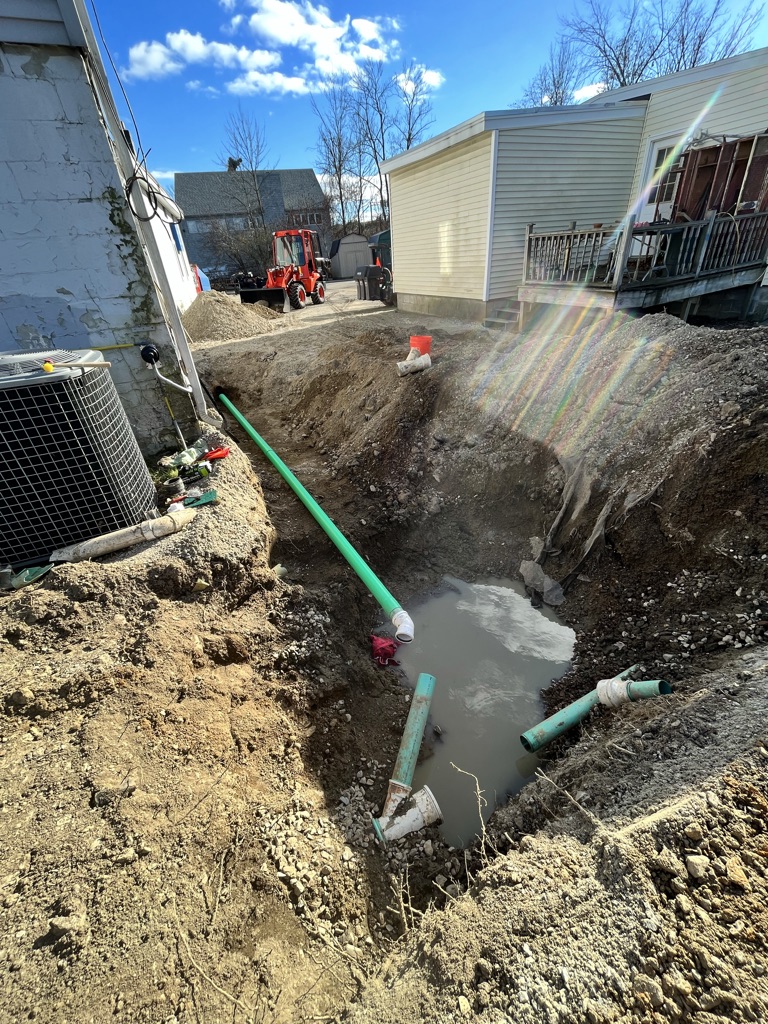


Sewer line replacement in NH & Maine: methods, factors and signs it is time


Sewer line replacement in NH and Maine isn't usually the first call a homeowner makes. It's the call that comes after a few too many backups, a camera inspection that turns up bad news, or a repair that just doesn't hold the way it used to. By the time replacement enters the conversation, most homeowners already suspect something bigger is going on underground.
Portsmouth, Dover, Exeter, and Durham all share a common thread: a lot of housing stock old enough that the original sewer line is decades past its intended lifespan. Clay and cast iron pipe that was standard decades ago simply wasn't built to last forever, and root systems from mature New England trees have had years to work their way into every joint and crack.
The difference between a line that needs another repair and one that needs full sewer line replacement saves homeowners from paying for the same fix twice. It also means understanding what the actual replacement process looks like, since trenchless methods have changed what used to be an automatic yard-destroying excavation.
In this article, you will learn about:
- Why sewer lines in NH and Maine wear out in the first place
- The signs a repair won't cut it anymore
- Trenchless replacement vs. traditional excavation
- What actually drives the cost and timeline
Keep reading to find out whether your sewer line problem is a quick fix or something that needs a real replacement plan.
Why do sewer lines in NH and Maine wear out in the first place?
Sewer lines fail for a small handful of predictable reasons, and almost all of them trace back to either the pipe's age, its material, or what's growing around it. Understanding which one applies to your home is the first step toward knowing whether repair or replacement actually makes sense.
These three causes account for the vast majority of the calls the team gets across Portsmouth, NH and the rest of the Seacoast footprint.
Root intrusion cracks pipe from the outside in
Root intrusion is the most common reason a healthy-looking sewer line fails years before its expected lifespan. Tree roots seek out the moisture and nutrients inside a sewer line, and they're relentless about finding any weak point, whether that's a loose joint, a hairline crack, or an old clay seam.
Once roots get a foothold, they grow thicker inside the pipe over time, slowing flow and eventually cracking the pipe outright from the pressure. Root intrusion in Dover, NH tends to follow the same pattern seen across the rest of the Seacoast, where cutting the roots out clears the immediate blockage but leaves pipe damage that only gets worse with each new intrusion.
Clay and cast iron pipe simply reaches the end of its life
A lot of homes across the Seacoast still have their original clay or cast iron sewer line, especially in older neighborhoods around Dover, NH and Exeter, NH. Both materials were standard for decades, and both have a finite service life that eventually runs out regardless of how well the line has been maintained.
Clay pipe tends to crack and shift as the ground around it settles over the decades. Cast iron corrodes from the inside, gradually losing wall thickness until it develops holes or collapses under its own weight. Why Portsmouth's older homes see this problem more than newer construction comes down almost entirely to what material sits in the ground.
The scale of the problem is bigger than any one home. The U.S. Environmental Protection Agency documented $1.3 billion in wastewater infrastructure needs across New Hampshire, including a 121 percent jump in pipe repair and replacement costs over a four-year survey period.
Bellied or settled sections trap waste and invite backups
A bellied section is a low spot in the pipe where the ground has settled unevenly, creating a dip that traps waste and water instead of letting it flow straight through to the main. Even a pipe that's structurally sound elsewhere can develop a belly from soil movement, tree root pressure, or the original installation simply not being sloped correctly.
Bellied sections cause recurring clogs in the exact same spot no matter how often the line gets cleared, since the underlying dip never goes away on its own. A few signs point toward a bellied line specifically:
- The same section clogs repeatedly even after cleaning
- Water drains slowly through one part of the yard but not others
- A camera inspection shows standing water sitting in a low spot between clear sections
- A sewer line clean out gets used far more often than it should for a line that age
Once a belly is confirmed, snaking or jetting only offers temporary relief, since the physical dip in the pipe stays exactly where it is.
The signs a repair won't cut it anymore
Not every sewer line problem means replacement. Plenty of issues, from a single root clog to a minor crack, respond well to targeted repair. The trick is recognizing when the pattern of problems has shifted from occasional to structural.
These three signs are the clearest indicators that another repair is just delaying the inevitable.
You're calling about the same backup every few months
A single sewer backup can happen to almost any home and doesn't necessarily point to a failing line. A backup that keeps coming back every few months, especially in the same part of the house, is a different story entirely.
Recurring backups usually mean the underlying damage, whether that's root intrusion, a bellied section, or a partially collapsed pipe, is still there even after each cleaning. A pattern worth tracking before calling for another repair:
- How many months pass between each backup
- Whether the backup happens in the same fixture or drain every time
- Whether the last camera inspection showed new damage compared to the one before it
- Whether snaking alone has stopped clearing the line completely
Homeowners in Somersworth and Rochester, NH with this kind of repeat pattern are exactly the cases where a full inspection usually reveals the line needs more than another snake job. How Durham homeowners can tell if it's a simple clog or a deeper sewer line problem often comes down to exactly this pattern of repeat timing.
The camera shows a collapsed or offset section
A sewer camera inspection gives the clearest possible answer to whether a line needs repair or replacement. Instead of guessing based on symptoms at the surface, a camera run through the line shows exactly what's happening underground.
A collapsed section, a significant offset where two pipe segments no longer line up, or widespread cracking across multiple joints all point toward replacement rather than a spot repair. A single crack or root ball in an otherwise sound pipe, on the other hand, is often fixable without touching the rest of the line. Sewer line inspection signs like these are exactly what a professional inspection is built to catch before the problem gets worse.
Snaking and jetting stop making a real difference
Snaking and hydro jetting both clear blockages effectively when the pipe itself is structurally sound. When those same services stop holding, and the line clogs again within weeks instead of months or years, that's usually a sign the pipe's condition has moved past what routine cleaning can fix.
A few patterns tend to show up right before a homeowner makes the switch from repair to replacement:
- The interval between cleanings keeps shrinking with each visit
- Jetting clears the immediate clog but flow never fully returns to normal
- A follow-up camera inspection shows new damage that wasn't there before
- A previously reliable line suddenly needs service multiple times in one season
Any one of these on its own justifies a second opinion, and more than one together usually means the conversation needs to shift from repair to replacement.
Trenchless replacement vs. traditional excavation
Once replacement is on the table, the next real decision is how it gets done. Traditional excavation and trenchless replacement both solve the same underlying problem, but they get there in very different ways, with different levels of disruption to the property.
Neither method is universally better. The right choice depends on the specific pipe, the property, and what's sitting on top of the line that needs to be worked around.
When traditional excavation is still the right call
Traditional sewer line excavation involves digging a trench along the length of the failing pipe to expose and replace it directly. It's the more invasive of the two methods, but it's also the most straightforward when the pipe's condition, depth, or surrounding obstacles make a trenchless approach impractical.
Severely collapsed sections, pipe that's shifted significantly out of alignment, or a line running under an area that's already scheduled for other work often call for full sewer line excavation regardless of the added disruption.
It also remains the more predictable option when a project genuinely needs full visual confirmation of the surrounding soil and pipe condition during the work itself, which is standard practice for homes in Eliot, ME and York, ME with older, unmapped sewer connections.
What trenchless methods actually spare your yard
Trenchless replacement installs a new pipe inside or alongside the old one without digging a continuous trench, usually through a pipe bursting or lining process that only requires small access points at each end of the run. For a homeowner, that difference shows up immediately in what's left of the yard, the driveway, or any landscaping sitting on top of the old line.
The tradeoff is that trenchless methods aren't the right fit for every situation. A severely misaligned or crushed pipe, or a line with an unusual bend the new pipe can't follow, may still need sewer line excavation to get a clean, reliable result rather than forcing a trenchless approach onto a pipe that can't support it.
How Seacoast decides which method fits your property
The decision between trenchless and excavation comes down to what the camera inspection actually shows, combined with what's realistic given the property itself. A few factors typically settle the question:
- How consistent the damage is along the length of the pipe
- Whether the pipe has any sharp bends or unusual routing
- What sits on top of the line, from mature trees to a driveway or patio
- How deep the line runs and what that means for excavation support
A straight run of pipe with consistent damage is often a strong trenchless candidate. A line with a sharp bend, a collapsed section, or damage that varies significantly along its length usually points toward excavation instead. The team walks through both options with the homeowner before any work starts, using the same right-tool-for-the-job approach that applies to every service call, rather than defaulting to whichever method is easiest to schedule.
What actually drives the cost and timeline
Sewer line replacement costs vary enough from one property to the next that a single flat number rarely means much. What actually drives the price and the schedule comes down to a handful of specific factors, most of which only become clear once the line has been inspected.
Understanding these factors ahead of time makes the eventual quote easier to interpret, and makes it obvious why two houses on the same street can end up with very different numbers.
Pipe length, depth, and material change the scope
A short run of pipe close to the surface is a fundamentally different job than a long line buried deep under a driveway or a mature landscape bed. Depth affects how much material needs to move and how much shoring or support the work requires, especially with traditional excavation.
Material matters too. Replacing an existing clay or cast iron line with modern PVC is straightforward from a materials standpoint, but the length and depth of that specific run still set the baseline for labor and equipment time regardless of what it's being replaced with. Cost factors for sewer replacement always come back to these same variables before anything else gets factored in.
Permitting and locating utilities adds lead time
Before any digging or trenchless work begins, the utilities running near the sewer line need to be located and marked. Gas, water, electric, and other buried lines all have to be accounted for, since damaging one of them turns a planned replacement into a much bigger problem.
Local permitting requirements add another layer, since municipalities across the Seacoast footprint each have their own process for approving sewer work, especially where the line crosses public right-of-way. None of this is unusual, but it's part of why a replacement timeline includes more than just the days spent actually working on the pipe.
Why the lowest quote isn't always the smart choice
A sewer line replacement is not a project most homeowners want to repeat in five years because the cheapest option cut corners the first time around. The lowest quote sometimes reflects a genuinely efficient crew, but it can also mean a shorter warranty period, lower-grade materials, or a plan to use traditional excavation when a more appropriate trenchless method was simply skipped to save time.
A few questions are worth asking before choosing based on price alone:
- What specific method is being used, and why was it chosen for this property
- What material is the new pipe, and how does it compare to what's being removed
- What does the workmanship guarantee actually cover
- Who handles permitting and utility locating, and is that included in the quote
Homeowners weighing sewer line repair contractors in Portsmouth usually find that the right price reflects the right scope of work for the actual condition of the pipe, not just whichever number came in lowest on paper.
Conclusion
Sewer line replacement in NH and Maine almost always traces back to the same handful of causes: root intrusion, aging clay or cast iron pipe, and settled or bellied sections that trap waste no matter how often they're cleared. Recognizing the difference between a line that needs another repair and one that's reached the end of its service life saves homeowners from paying for temporary fixes on a permanent problem.
Once replacement is the right call, the choice between trenchless methods and traditional excavation comes down to what the pipe's actual condition allows, not just which option sounds less disruptive. Cost and timeline follow from the same specifics: pipe length, depth, material, and the permitting work that has to happen before anyone breaks ground.
If a sewer line on your property has been giving you the same trouble more than once, Seacoast Sewer and Drain can run a camera inspection and give you a straight answer on whether it's a repair or a replacement, along with which method actually fits your yard. The team has handled enough of these across the Seacoast to know the difference between a line worth saving and one that isn't.
Recent Blog Post
Customer Reviews