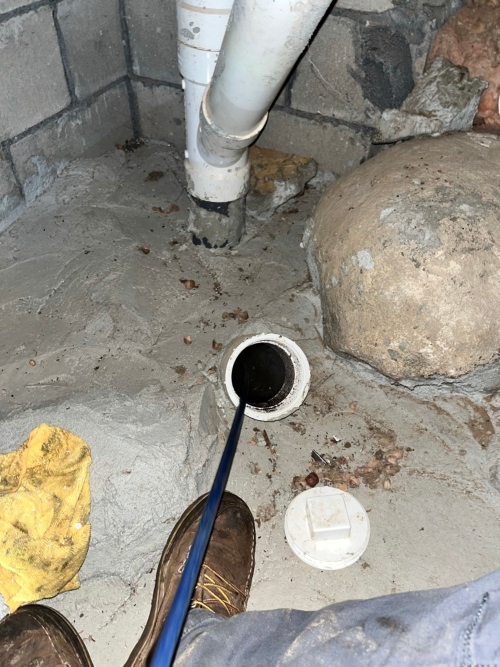


A sewer line clean out is one of those features most homeowners never think about until the day they desperately need it. It sits quietly outside or near the foundation, doing nothing most of the year, until a backup turns it into the single most useful pipe fitting on the property.
The confusion around cleanouts usually comes from not knowing what one actually is versus what it does. A cleanout is not a drain. Nothing flows through it during normal use. It exists purely as an access point, a doorway into the sewer line that lets a technician reach a clog without tearing into a wall or digging up a yard.
Seacoast homes add some real variation to this picture. Older properties in Durham, Portsmouth, and the surrounding towns were not always built with a cleanout in the first place, since many predate the codes that require one. Knowing whether a property has one, where it is, and when it actually gets used changes how fast a backup gets resolved.
In this article, you will learn about:
- What a sewer line clean out actually is and how it works
- Where cleanouts are typically located on a property
- The situations that call for using one
- What to do if a home does not have one
Keep reading to find out whether your home has one, and what it means if it doesn't.
What a sewer line clean out actually is
A sewer line clean out is a capped pipe fitting that connects directly to the main line running from a house to the street or septic system. Removing the cap gives direct, straight-line access to the pipe, which is exactly what a technician needs to run a cable, a jetting hose, or a camera without going through an indoor fixture.
Without a cleanout, clearing a main line clog means going in through a toilet, a floor drain, or occasionally a roof vent, all of which are slower, messier, and far less direct than a purpose-built access point. This is part of why emergency drain cleaning calls tend to take longer and cost more on homes without one.
The difference between a drain and a cleanout
A drain carries wastewater away from a fixture during normal use. A cleanout does the opposite: it stays sealed and untouched until something needs to be inspected or cleared. Confusing the two is common, since both are pipe openings, but they serve completely different purposes.
Understanding this distinction matters because a homeowner who tries to use a cleanout as a drain, or who assumes a random pipe cap in the yard is just decorative, can miss the one access point that would make a future backup far easier to resolve.
Why it exists in the first place
The purpose of a cleanout is entirely about access, not flow. Sewer lines run underground or through walls, and without a dedicated opening, diagnosing or clearing a clog anywhere along that line would require cutting into the pipe itself or opening up flooring and drywall.
A few situations make that access point essential rather than optional:
- A clog too far down the line for a fixture-based approach to reach
- A camera inspection that needs a clear, straight path into the pipe
- Routine jetting or maintenance that would otherwise disturb an indoor fixture
A cleanout solves that by giving a straight run into the line at a known, fixed point. This single feature is why professional drain cleaning and camera inspections can usually be done in an hour or two rather than turning into a full-day project involving demolition.
How building codes shaped where these ended up
Modern plumbing codes require cleanouts at specific intervals and locations, which is why newer homes almost always have at least one clearly placed near the foundation. According to the State of New Hampshire, the state has adopted the International Plumbing Code for all plumbing installation, alteration, and repair work, which sets cleanout spacing and placement requirements statewide.
Older homes built before these code requirements took effect often have no cleanout at all, or one installed later in a less convenient spot. This gap in coverage across the Seacoast's older housing stock, where the median home in New Hampshire was built around 1979, is one of the more common surprises homeowners run into during their first real plumbing emergency.
Where cleanouts are typically found on a property
Knowing what a cleanout looks like only helps if a homeowner also knows roughly where to look. Cleanouts follow a few predictable patterns, though the exact location varies by home age, foundation type, and how the original plumbing was laid out.
Most homes have more than one cleanout, since codes require access points at specific junctions and distance intervals along the line, not just a single opening near the house. Knowing all of them, not just the most obvious one, matters when a technician needs to isolate exactly where a blockage sits.
Three general locations account for the overwhelming majority of cleanout placements.
Near the foundation
The most common cleanout sits within a few feet of where the sewer line exits the house, often marked by a capped pipe rising slightly above ground level or flush with a basement floor. This is usually the first cleanout a technician checks, since it provides access to the entire run toward the street.
- A vertical pipe with a screw cap, often three to four inches in diameter
- Sometimes painted or capped in a color that blends with surrounding landscaping
- Occasionally located inside a basement or crawl space rather than outside
Near the property line
A second cleanout often sits closer to where the private line connects to the public sewer main, especially on properties with a longer run between the house and the street. This location helps a technician determine whether a blockage sits closer to the house or farther out toward the connection point.
Having access at both ends of the line means a partial blockage can be isolated to a specific section rather than requiring the entire run to be inspected from a single access point.
At changes in direction
Anywhere the line makes a significant turn, codes typically require an additional cleanout, since sharp bends are common spots for debris and root intrusion to catch and build up over time. The U.S. Forest Service documents tree root intrusion as a leading cause of sewer line blockages nationally, and turns in the line are a common entry point. These intermediate access points are less obvious to a homeowner but matter just as much during a diagnosis.
A property with several turns in its sewer line, common in older, irregularly shaped lots across Exeter and the Seacoast, may have more of these intermediate cleanouts than a simple, straight-line layout would need.
When a homeowner actually needs to use one
Most of the time, a cleanout sits untouched. The situations that call for actually removing the cap and using it are specific, and recognizing them early usually means a faster, less expensive resolution.
Understanding these situations ahead of time also helps a homeowner communicate more clearly with a technician over the phone, which speeds up the entire process once someone arrives.
A backup affecting more than one fixture
When multiple drains slow down or back up at the same time, especially the lowest drain in the house, the blockage usually sits in the main line rather than a single branch. A cleanout gives the fastest, most direct path to that main line without disturbing indoor fixtures.
- Multiple fixtures showing symptoms points toward the main line, not a single drain
- The nearest cleanout to the house is usually the first access point tried
- A second cleanout near the property line helps narrow down the blockage location
- Camera equipment inserted through a cleanout can travel the full length of the line
Routine preventative maintenance
Even without an active backup, a cleanout provides the access point for scheduled maintenance like jetting or a periodic camera inspection. This is particularly useful for older Seacoast homes with mature trees nearby, where root intrusion tends to build gradually over multiple seasons.
Using the cleanout for preventative maintenance avoids the wear and disruption that comes from repeatedly accessing the line through an indoor fixture, and it usually takes less time overall.
Before a home sale or major renovation
A video pipe inspection through the cleanout is increasingly common before a home sale, since buyers and their inspectors want to know the condition of a line that is otherwise invisible. Catching a developing problem before it becomes a full backup gives a seller time to address it on their own terms rather than during a stressful negotiation.
Renovations that involve excavation near the foundation are also a good moment to confirm the cleanout's condition and location, since a damaged or buried cleanout is far easier to fix while the ground is already open.
What to do if a home doesn't have one
Older Seacoast homes, particularly those built before modern plumbing codes took effect, sometimes have no cleanout at all, or one that has been paved over, buried, or built around during a past renovation. This is more common than most homeowners realize until a plumbing repair call actually goes looking for one.
Not having a cleanout does not mean a home cannot be serviced, but it does mean every service call takes longer and often costs more, since a technician has to find another way into the line.
Confirming whether one exists
A quick way to check is looking for a capped pipe near where the main line likely exits the foundation, though older installations are not always obvious or where a modern homeowner would expect. A professional can often locate a buried or hidden cleanout with a metal detector or by tracing the line from an interior fixture.
Before assuming a home has none, it is worth checking a basement floor, a crawl space, and the exterior perimeter near the foundation, since cleanouts are not always placed in the most convenient or visible spot.
Getting one installed
Installing a new cleanout is a relatively minor project compared to most sewer line work, typically involving a small excavation to expose the line at an accessible point and installing a wye or tee fitting with a cap. Once in place, it immediately makes every future service call faster and less invasive.
- A small section of yard or driveway may need to be opened briefly
- The new cleanout should be placed within a few feet of the foundation for easiest future access
- A permit is often required, even for a project this size, depending on the municipality
Weighing the upfront cost against future savings
Homeowners sometimes hesitate at the cost of adding a cleanout to a home that has functioned without one for decades. That hesitation usually fades the first time a drain snaking service call without one takes twice as long and costs noticeably more because a technician had to work through an indoor fixture instead.
A few numbers make the case clearly:
- A cleanout-based service call is often 30 to 60 minutes faster than one requiring fixture access
- Camera inspections through a cleanout rarely require removing a toilet or opening a wall
- The one-time cost of adding a cleanout is typically far less than a single avoided emergency call
A cleanout is a small, one-time investment that pays off gradually every time it turns what could have been a half-day project into a quick, straightforward fix.
Conclusion
A sewer line clean out rarely gets attention until the moment it is needed, and by then, having one already in place makes all the difference in how fast and how affordably a backup gets resolved. It is not a drain and it is not decorative. It is a dedicated access point that exists purely to make future service faster.
Seacoast homes carry a wide range of ages and layouts, and that means cleanout locations, or their absence entirely, vary more here than in a newer, more uniform housing market. Knowing where a property's cleanouts sit, or confirming that none exist, is worth doing before a backup forces the question at the worst possible time.
Whether a home already has a cleanout in a hard-to-find spot or needs one installed for the first time, the small effort of confirming it now saves real time and money the next time a drain backs up.
If you are not sure whether your Seacoast property has a working cleanout, or want one properly located and installed, Seacoast Sewer and Drain can find out and take care of it. Contact Seacoast Sewer and Drain to get a straight answer about your line.
Recent Blog Post
Customer Reviews