

Sewer camera inspection in Exeter, NH: what it finds before you have a real problem


By the time a sewer problem announces itself with a backup, it has usually been developing quietly for months. A sewer camera inspection is how you see that development before it turns into a flooded basement or an emergency call on a Sunday night.
Exeter has a particular reason to take this seriously. The town's older housing stock near the historic downtown sits close to the Squamscott River, where tidal influence on the local water table adds a layer of pressure that inland Seacoast towns do not deal with in the same way. Pipe that would hold up fine somewhere else can behave differently here.
A camera does not guess. Every video camera sewer inspection shows the actual condition of the pipe, the exact location of a problem, and whether that problem is something to monitor or something to fix now. That distinction is what separates a homeowner who plans a repair on their own schedule from one who deals with it as an emergency.
In this article, you will learn about:
- What a sewer camera inspection actually shows underground
- The specific problems it catches in Exeter's older homes
- How tidal influence near the Squamscott adds risk that inspection helps manage
- What happens after an inspection finds something worth addressing
Keep reading to see why a camera inspection is one of the most useful things you can do for an older Exeter home before a problem becomes obvious on its own.
What a sewer camera inspection actually shows
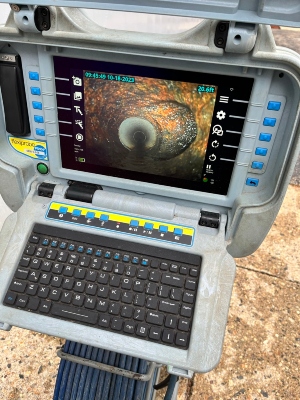
A sewer camera inspection sends a waterproof camera through the line, usually via the cleanout or another access point, and streams a live video feed back to the technician. It is the closest thing to actually walking the length of your pipe without digging it up.
That live view does more than confirm there is a clog. It shows the pipe's material, its condition, the exact location of any damage, and how far that damage extends, which is information no amount of guessing from the surface can provide.
The process itself
The equipment is simpler than people expect, and the process is minimally invasive. A technician locates the nearest cleanout, feeds the camera through, and watches the footage in real time while noting anything worth flagging along the way.
- The technician identifies the best access point, typically an exterior cleanout
- A waterproof camera on a flexible cable is fed through the line
- The live feed shows the interior condition as the camera advances
- Depth markers and a locator help pinpoint exactly where any issue sits
- The homeowner gets a clear explanation of what was found, on the spot
That last step matters as much as the technology itself. A homeowner should walk away from an inspection understanding exactly what is happening in their pipe, not just told that "something" was found.
What separates a good inspection from a rushed one
Not every camera pass through a pipe produces the same quality of information. A rushed inspection that only confirms a blockage exists misses the more useful question: what caused it, and is the surrounding pipe still sound.
- A thorough inspection notes the pipe material, since clay, cast iron, and PVC each fail differently
- It records the precise depth and location of any defect, not just a general area
- It distinguishes between a temporary blockage and a structural pipe problem
- It documents the condition well enough to compare against a future inspection
That documentation is what makes pipe camera diagnostics valuable beyond the moment they happen. A homeowner with a clear record of pipe condition today has something concrete to compare against if a new symptom shows up two years from now.
Problems a camera catches early in Exeter's older homes
Exeter's mix of historic downtown homes and newer development outside the center means sewer line age varies block by block more than in some neighboring towns. Older sections of pipe, especially clay and cast iron, are exactly the material most likely to develop the kinds of problems a camera catches before they become visible from inside the house.
Root intrusion tops the list almost everywhere in this region. Research from the U.S. Forest Service found that tree roots contribute to more than half of all sewer line blockages, and Exeter's mature street trees near its older neighborhoods put a meaningful share of local homes at risk of the same tree root damage that shows up across the wider Seacoast.
Root intrusion before it causes a backup
A camera can spot a thin feeder root working its way through a joint long before that root has grown large enough to actually block the line. Catching it at that stage usually means a straightforward clearing job rather than an emergency call.
- Small root threads visible at a joint, well before they trap debris
- The exact joint or section where the intrusion is occurring
- Whether nearby joints show early signs of the same vulnerability
- How much clearance remains before flow is meaningfully restricted
Homeowners who wait for symptoms to show up on their own are, by definition, catching the problem later than a camera would have. The gap between "roots are present" and an actual sewer backup problem can be a year or more, and that gap is exactly when a smaller fix is still possible.
Pipe corrosion and structural wear
Cast iron pipe corrodes from the inside, narrowing gradually as buildup accumulates along the interior wall. That narrowing is invisible from outside the house and produces no symptoms until it has progressed far enough to slow drainage noticeably.
A camera catches this well before that point, showing exactly how much the interior diameter has shrunk and whether the surrounding pipe wall still looks structurally sound for residential sewer repair purposes. That early read is often the difference between a maintenance conversation and a replacement conversation.
Pitch and installation issues from older construction
Some of Exeter's older sewer lines were installed before the pitch standards used in modern code existed. A line with too little slope lets solids settle rather than flow all the way to the main, setting up recurring clogs that have nothing to do with roots or corrosion at all.
This is a problem a camera identifies clearly but a homeowner cannot diagnose from symptoms alone, since a pitch issue and a root issue can look identical from a slow drain upstairs, which is exactly why sewer cleaning solutions start with an actual look inside the line rather than a guess.
How tidal influence near the Squamscott adds risk
Exeter's location on the Squamscott River, a tidally influenced waterway, means the local water table behaves differently than it does further inland. That difference matters for sewer pipe in ways most homeowners never think about until it becomes a problem.
Research on tidally influenced groundwater in Portsmouth, further up the Seacoast, documented how tidal forcing and rainwater saturation combine to push local groundwater levels higher than a purely inland town would ever see. Exeter's proximity to the Squamscott creates a similar dynamic on a smaller scale.
Why a higher water table stresses older pipe
A higher water table puts more external pressure on sewer pipe, and it pushes groundwater into any existing crack or loose joint far more aggressively than dry soil would. According to the EPA, leaky sewer infrastructure allows groundwater and stormwater to infiltrate through cracks and faulty joints, which can overload a line that was already compromised.
That infiltration risk climbs with the tide, not just with the weather. A pipe that seems fine during a dry stretch can behave very differently during a period of high tides stacked with heavy rain, which is exactly the kind of pattern a homeowner would not connect to their sewer line without an inspection pointing it out.
- High tide raises the local groundwater level around buried pipe
- Existing cracks or loose joints let that groundwater seep in
- The added volume stresses a line that may already be near capacity
- Symptoms show up during or shortly after wet, high-tide periods, then seem to disappear
That intermittent pattern is part of why homeowners near the river sometimes describe their sewer issues as unpredictable, and it is the same reason emergency drain cleaning calls near the water tend to cluster around wet, high-tide stretches. A camera inspection timed appropriately can catch signs of infiltration that a dry-weather look might miss entirely.
Why this makes Exeter homes a stronger case for regular inspection
Homes further from the water table's tidal influence can sometimes get away with a less frequent inspection schedule. Properties near the Squamscott generally cannot, since the added groundwater pressure accelerates wear on any existing defect faster than it would elsewhere in the Seacoast.
A sewer line inspection on a schedule that accounts for this local factor, rather than a generic annual reminder, is the more realistic approach for anyone in this part of town.
What happens after an inspection finds something
Finding an issue on camera is only useful if it leads to the right next step. Not every finding calls for the same response, and matching the fix to what was actually found is where a lot of homeowners either save money or waste it.
Right tool for the job applies here as much as anywhere else in this trade. A minor root intrusion caught early does not need the same response as a collapsed section of cast iron, and treating them the same wastes time on one end and risks under-treating a real problem on the other.
When jetting or clearing is enough
If the camera shows the pipe structure is sound and the issue is buildup, early root growth, or debris inside an otherwise intact line, hydro jetting usually clears it without any excavation at all.
- The pipe walls show no cracking, offsetting, or structural failure
- The blockage is buildup, grease, or roots rather than a physical break
- A follow-up camera pass after jetting confirms the line is genuinely clear
- The homeowner gets a same-day resolution in most cases
That last point is often the most welcome news a homeowner gets from an inspection. Many problems that feel alarming when a drain first slows down turn out to be exactly the kind of issue residential drain snaking or jetting resolves in a single visit.
When excavation becomes the honest answer
If the camera shows a structural failure, whether that is a collapsed section, a severe crack, or corrosion that has narrowed cast iron pipe past the point jetting can help, clearing the line will not solve the actual problem. In that case, a targeted sewer line excavation limited to the failed section is the honest recommendation, even though it costs more upfront than another round of clearing, and understanding cost factors for sewer replacement upfront helps homeowners plan for that instead of being caught off guard.
Camera-guided excavation means the dig is confined to the specific problem area rather than the full run of pipe from house to street. That precision is only possible because the camera already showed exactly where the failure sits.
Building a follow-up plan instead of walking away
An inspection that finds nothing urgent is not a wasted visit. It establishes a baseline condition for the pipe, which becomes genuinely useful the next time a symptom shows up and someone needs to know whether the pipe has changed since the last look.
Homes with known risk factors, whether that is proximity to the Squamscott, mature trees near the line, or a documented history of root intrusion jetting, benefit from a follow-up schedule built around that specific risk rather than a one-size-fits-all annual check.
Conclusion
A sewer camera inspection turns a guessing game into a straightforward diagnosis, and in a town like Exeter, where older pipe, mature trees, and a tidally influenced water table all overlap, that diagnosis is worth more than it would be in a town with fewer variables working against the pipe.
The homeowners who avoid the surprise backup are almost always the ones who looked before there was an obvious reason to. A camera inspection costs a fraction of what an emergency repair does, and it gives you an actual answer instead of a guess about what is happening under your yard.
If your Exeter home has never had its sewer line camera inspected, or if you are near the Squamscott and have noticed drainage that seems to act up during wet, high-tide stretches, it is worth getting a professional look now rather than waiting for a clearer sign. Reach out to Seacoast Sewer and Drain to schedule a camera inspection before a small issue becomes a real one.
Recent Blog Post
Customer Reviews