

Why do tree roots keep coming back in my sewer line? A Seacoast guide to root intrusion


You had the line cleared six months ago. Maybe less. Now the tub is draining slow again, the toilet gurgles when the washing machine runs, and you're standing in the yard wondering if you just paid for a problem that never actually went away.
You didn't get scammed. Roots are relentless, and clearing them once rarely means clearing them for good. A crew can run a blade through a mass of roots and leave the crack, joint gap, or low spot that let them in untouched. The roots grow back into the exact same opening, sometimes within months, because nothing addressed why they got in there in the first place.
Across Portsmouth, Dover, Exeter, and Durham, this is one of the most common calls Seacoast Sewer and Drain gets. Homes here are older, pipe materials vary block by block, and mature trees line most of the neighborhoods that make this area what it is. Root intrusion isn't a rare fluke. It's a predictable, mechanical problem with a fixable cause, and understanding that cause is the difference between paying to clear the same clog every year and actually solving it.
In this article, you will learn about:
- Why tree roots keep finding their way back into the same sewer line
- How to tell the difference between a temporary clog and a structural root problem
- What actually stops roots from regrowing after removal
- When repeated root intrusion means it's time to replace the line
Keep reading to understand why the "just snake it again" approach keeps costing you money, and what actually breaks the cycle.
Why do tree roots target your sewer line in the first place?
Roots don't grow toward pipes because they sense pipes. They grow toward water, oxygen, and nutrients, and a sewer line leaking even a small amount of moisture through a crack or a loose joint is exactly what a thirsty root system is looking for. Once a root finds that moisture, it doesn't stop. It thickens, branches, and pulls in more roots behind it.
That's why root intrusion is almost never really a "roots problem." It's a pipe problem that roots happen to exploit. Research published through the USDA Forest Service has found that root intrusion tends to occur where a sewer line already has cracks or leaking joints, with roots acting as opportunists rather than the original cause of the damage. Fix the leak, and you remove the reason roots showed up at all.
How do roots actually get inside a pipe?
Sewer pipes are built with joints, and every joint is a potential entry point once the seal ages or shifts. Fine, hair-like roots find these tiny gaps first, working through cracks barely wide enough to see. Once inside, they don't stay small.
A single root that gets a foothold in a joint gap will keep growing as long as moisture keeps coming through. Over time it thickens into a mass that catches toilet paper, grease, and debris, which is usually what finally slows your drains enough to notice.
- Cracked or offset pipe joints from ground settling or freeze-thaw cycles
- Small fractures from age, corrosion, or a shifting foundation
- Loose fittings where two pipe sections were never sealed tightly enough
- Collapsed or bellied sections that pool water and attract roots even faster
Older homes tend to have more of these entry points simply because the pipe has had more decades to shift, corrode, or crack. That's part of why this is such a common call across the Seacoast specifically.
Which pipe materials are the most vulnerable?
Not all sewer pipe stands up to roots equally. Clay and cast iron, both common in homes built before the 1970s, develop joint gaps and hairline cracks far more easily than modern materials. USDA Forest Service researchers surveying municipal tree managers found that older clay and concrete pipe tends to hold surface moisture more than modern PVC plastic, which makes it a more attractive target for root growth from the outside in.
Modern PVC pipe, by comparison, is manufactured in longer continuous sections with fewer joints and tighter seals, giving roots far fewer opportunities to find a way in. If your home still has its original clay lateral, that alone raises your odds of a recurring root problem, regardless of how many trees are nearby.
Why does the Seacoast see more of this than newer developments?
Portsmouth, Dover, Exeter, and Durham all have neighborhoods built well before modern plastic piping became standard, and mature tree canopy that has had decades to establish root systems near those same lines. That combination, old pipe plus established trees, is exactly the setup that produces chronic root problems.
Housing data compiled by the U.S. Census Bureau shows New Hampshire's owner-occupied homes have a median construction year in the late 1970s to early 1980s, which means a meaningful share of the housing stock predates the shift to PVC sewer lateral standards. Add in the region's freeze-thaw cycles, which stress pipe joints every winter, and you get a Seacoast-specific pattern: the same properties that give this area its character are often the ones most exposed to repeated root intrusion.
How can you tell it's roots and not just a normal clog?
A one-time clog from grease, wipes, or hair usually clears with a single snaking and stays clear. Root intrusion behaves differently. It comes back on a schedule, often every few months, because the entry point never went away between visits.
Watching for that pattern is the fastest way to know which problem you have before you spend money on the wrong fix. A few consistent signals point specifically to roots rather than ordinary buildup.
- Multiple drains slowing down at once, not just one fixture
- Gurgling in a toilet or tub when the washing machine or dishwasher runs
- Backups that show up on a recurring schedule, not randomly
- Sewage odor in the yard, especially near where the lateral runs
- An unusually lush or green patch of grass tracking the same path
Why does slow drainage show up in more than one fixture?
A localized clog, like hair in a bathroom sink trap, only affects that one fixture. Root intrusion sits further down the line in the main sewer lateral, which every drain in the house eventually feeds into. When roots partially block that shared line, everything upstream of the blockage slows down together.
That's the tell. If your kitchen sink, tub, and toilet are all draining sluggishly around the same time, the problem almost certainly isn't in any one of those fixtures. It's downstream, in the section of pipe they all share.
What does gurgling actually mean?
Gurgling happens when air gets trapped and displaced because water can't move through the pipe as freely as it should. A root mass narrows the pipe's interior, and as wastewater pushes past it, trapped air escapes back up through the nearest open drain, usually a toilet or tub.
- Water and waste enter the main line and hit the partial root blockage
- The restricted opening forces air backward through the path of least resistance
- That air bubbles up through standing water in a toilet bowl or tub trap
- You hear the gurgle exactly when another fixture is draining, not randomly
If that pattern lines up consistently with laundry day or dishwasher cycles, it's a strong sign the obstruction sits in the shared lateral rather than in an isolated fixture line.
Why does the same patch of grass keep coming back greener?
A cracked or leaking sewer line effectively fertilizes the soil directly above it. Wastewater carries nitrogen and organic material that roots and grass both feed on, so the ground above a compromised lateral often grows noticeably faster and greener than the rest of the yard, sometimes in a visible line tracking the pipe's path.
If you've noticed a strip of grass that always needs mowing before the rest of the lawn, especially one that lines up with where you know or suspect the sewer lateral runs, that's worth mentioning to whoever inspects the line. It's a strong visual confirmation of a leak, not just a coincidence.
What actually stops roots from growing back after removal?
This is where most of the frustration comes from. A basic snaking cuts a channel through the root mass and restores flow, but it doesn't remove the roots from the pipe wall, and it does nothing to fix the crack or joint gap that let them in. The channel refills as the roots keep growing toward the same moisture source.
Breaking that cycle takes two things: a cleaning method aggressive enough to actually clear root material rather than just punch a hole through it, and a real look at the pipe itself to understand why roots got in and whether the damage goes deeper than a single clog.
Why does hydro jetting outperform snaking for root problems?
A cable and blade tool bores a hole through the obstruction, which restores flow but leaves root material packed against the pipe walls, ready to regrow into that same opening. Hydro jetting works differently. It uses high-pressure water to scour the entire interior diameter of the pipe, stripping root material, grease, and buildup from the walls rather than just punching through the center.
The EPA links aging, cracked collection lines to the vast majority of the tens of thousands of sewer overflow events reported nationwide each year, which is why a method that actually scours the pipe wall matters more than one that just restores flow. Every Seacoast Sewer and Drain truck carries jetting equipment standard, not as an upsell, because it's often the right first move rather than a last resort after snaking fails.
Why does a camera inspection matter before deciding on a fix?
You can't fix what you can't see, and roots hide the real story. A camera run through the line after clearing shows exactly where the intrusion is happening, how many entry points exist, and whether the surrounding pipe has cracked, bellied, or shifted. That distinction changes the entire plan.
- A single small crack might only need a targeted repair at that section
- Multiple entry points along an old clay line suggest broader pipe failure
- A bellied section holding standing water will keep attracting roots regardless of how often it's cleared
- Root masses wrapped around a collapsed joint usually mean excavation is the fix
Skipping this step is how homeowners end up paying for the same snaking service every few months without ever learning why it keeps happening. An honest diagnosis, not just a repeat visit, is what actually saves money over time.
What should a maintenance plan look like once the line is clear?
Even after a thorough jetting and inspection, a line with a known weak point benefits from scheduled maintenance rather than waiting for the next backup. Nobody wants a surprise sewage backup on a holiday weekend, and a known problem area doesn't stay quiet forever on its own.
Building a light maintenance rhythm around that weak spot, rather than reacting every time symptoms return, keeps small root growth from ever reaching backup levels again. A technician who has already seen your line's specific trouble spot can target it directly instead of re-diagnosing from scratch every visit.
When does recurring root intrusion mean it's time to replace the line?
Not every root problem needs a full sewer line replacement. But when the same section keeps failing no matter how well it's cleaned, cleaning isn't the fix anymore. At some point the pipe itself has to be addressed directly.
A few honest signals tend to separate a line that still has life left from one that's genuinely done.
- Root regrowth returns within just a few months of a thorough jetting and inspection
- The camera shows a collapsed, bellied, or significantly offset section rather than an isolated crack
- The affected section is old clay or cast iron with multiple joints already compromised
- Backups are getting more frequent or more severe with each recurrence, not staying steady
How do you know if the pipe can still be saved?
The camera inspection answers this more reliably than guesswork ever will. A single hairline crack in an otherwise sound line is often repairable without touching the rest of the pipe. A line with multiple failing joints, a bellied low spot, or visible collapse is a different situation entirely, one where repeated clearing is just delaying an inevitable and more expensive failure.
The EPA estimates the nation's sewer collection systems represent well over a trillion dollars in infrastructure value, which is part of why rehabilitating a pipe before it fails outright almost always costs less than waiting for a full collapse. Replacing a line that only needed a spot repair wastes money. Repeatedly clearing a line that's actually failing wastes more.
What does sewer line excavation actually involve?
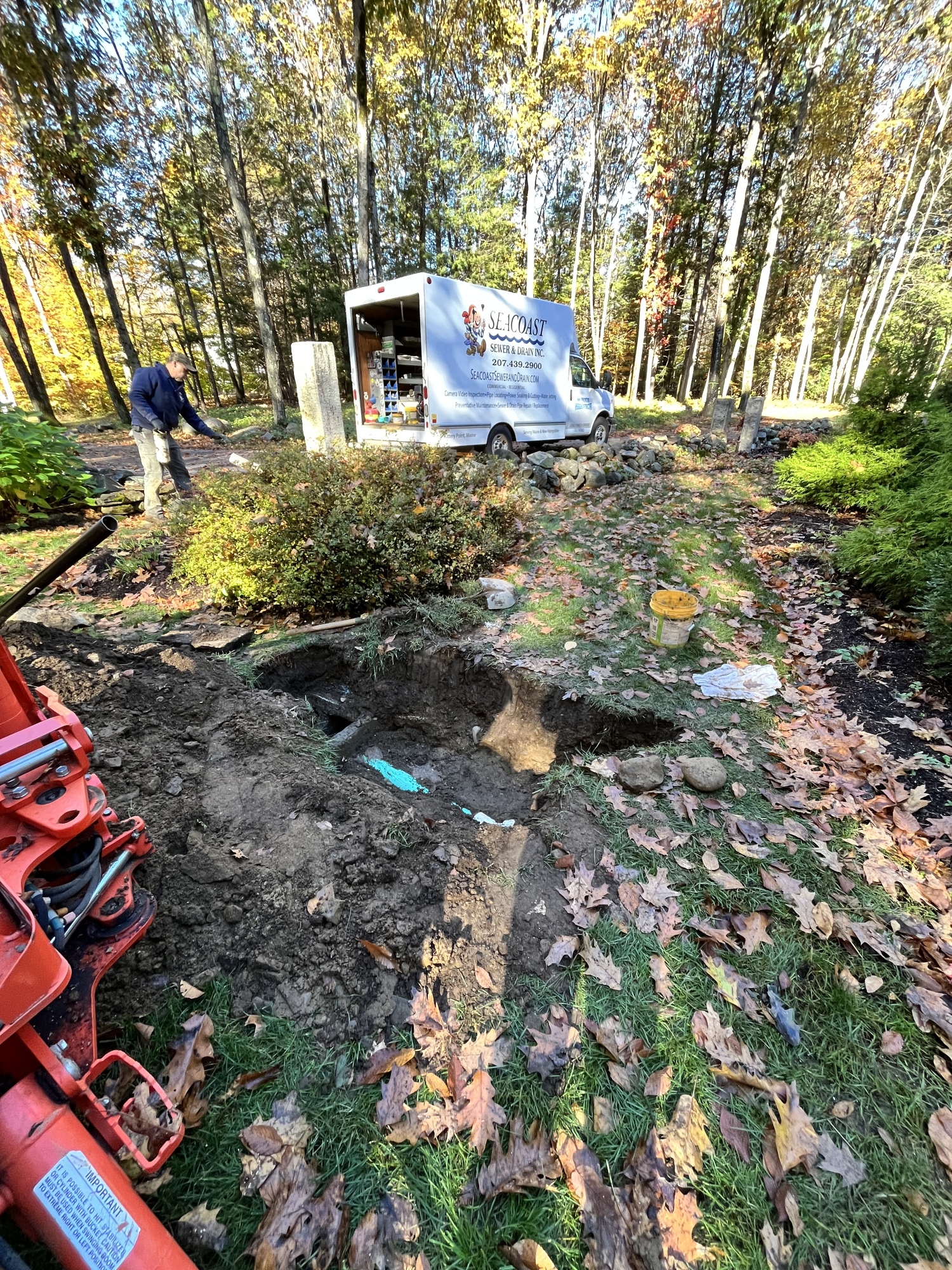
Excavation sounds more disruptive than it usually turns out to be for a residential lateral. In most cases, it means opening a targeted trench along the affected section, removing the damaged pipe, and installing new material with tight, root-resistant joints, then restoring the yard afterward.
- A camera and locate confirm the exact section that needs to come out
- The trench is dug only as wide and deep as that section requires
- Old clay or cast iron is removed and replaced with modern PVC
- Joints are sealed properly to remove the moisture leak that attracted roots originally
- The area is backfilled and graded back close to its original condition
This is a service more homeowners assume Seacoast doesn't offer than any other, but it's one the team actively wants to do more of, precisely because it's the permanent answer for lines that snaking alone will never fix.
Can a repaired line still get roots again?
A properly sealed, modern pipe with tight joints removes the moisture leak that attracted roots in the first place, which is what actually stops the cycle rather than just interrupting it temporarily. Roots don't seek out healthy pipe. They seek out leaks, and a well-installed replacement doesn't give them one.
That said, if large, aggressive tree roots run directly through the excavation path, a technician may recommend root barriers or rerouting the line slightly to avoid future conflict. It's a conversation worth having with a reliable excavation company on-site once the old section is exposed, not something to guess at from the yard.
Conclusion
Root intrusion feels like a problem that never gets solved because most of the time, it isn't actually being solved, just interrupted. Snaking clears the symptom. It doesn't address the crack, the joint gap, or the aging clay pipe that gave the roots an opening in the first place, so the roots come right back to the same spot.
If you've paid for the same drain clearing more than once in the past year, that's not bad luck. It's a sign the real issue is still sitting in the ground, waiting to regrow. A camera inspection and an honest look at the pipe itself will tell you whether you're dealing with a quick fix or a line that's finally ready to be replaced for good.
Seacoast Sewer and Drain runs hydro jetting on every truck, not as a premium upsell, and won't recommend excavation unless the camera actually shows you need it. If your drains keep backing up on a schedule you could set a clock to, it's time for a real diagnosis instead of another temporary fix. Reach out to Seacoast Sewer and Drain and get the problem solved at the source.
Recent Blog Post
Customer Reviews